New Products

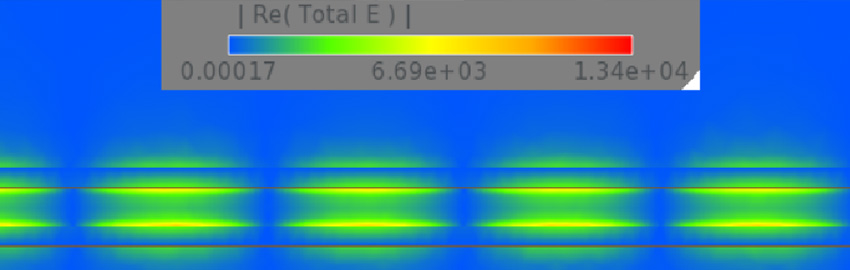
Laminate and prepreg material targets high-speed digital designs by eliminating fiber weave skew through proprietary resin and reinforcement technologies. The material supports differential signaling at 224Gbps PAM4 and beyond, addressing timing mismatch caused by glass weave structures in traditional laminates. It delivers dielectric constant (Dk) of 2.80 and dissipation factor (Df) of 0.0007, stable across frequency up to 110GHz. Measured insertion loss is approximately 1.05dB/inch at 56GHz on 7-mil differential pairs with HVLP4 copper, with lower loss projected using HVLP5. The material supports standard FR-4 processing, including CO2 and UV laser drilling, with no fiber pull-out or residue. It provides peel strength greater than 5pli on HVLP4 copper and supports stacked microvia reliability through 500-cycle testing. Designed for applications including PCIe 7 and next-generation high-speed interconnects, the laminate enables consistent signal integrity without requiring panel rotation or routing compensation techniques.

Read more ...

Version 10 PCB design software introduces updates for schematic capture, PCB layout and design workflow management. Supports design variants, lasso selection and customizable toolbars, along with import capabilities for Allegro, PADS and gEDA formats. PCB design enhancements include time-domain track tuning, graphical design rule editing and expanded design block functionality. Adds support for inner-layer objects in footprints, pin and gate swap, and improved DRC workflows. Library updates include STEP-based 3D models and expanded symbol, footprint and model libraries. Designed to support complex PCB design workflows and improve usability, performance and interoperability across electronics design environments.

Read more ...

Fuse EDA AI Agent is an autonomous workflow orchestration system designed to manage semiconductor, 3D IC and PCB design processes across the full electronic design automation lifecycle. The system coordinates multi-tool and multi-agent workflows spanning design, verification and manufacturing sign-off, supporting automation of tasks such as RTL development, testbench generation, place-and-route, timing analysis and design rule checking.

Read more ...

Octopart Discover platform supports electronics component discovery by linking system intent, functional blocks, and design constraints to component and solution evaluation. Platform is designed to move engineers beyond traditional part-number searches by aligning results with architecture requirements and design context during early development stages. Discovery tools retain system context as engineers compare options, allowing constraints, prior selections, and architecture decisions to remain connected during evaluation. When requirements change, results can be adjusted without restarting the discovery process. Platform integrates with design and data environments including CAD, PLM and partner data sources to maintain alignment between system-level decisions and available component options. Discovery tools are intended to support early-stage design exploration where cost structure, performance limits, and reliability decisions are established. Octopart Discover will be demonstrated at embedded world in Nuremberg and is expected to become available in the second half of 2026.

Read more ...

MCJ Series surface-mount jumper chip resistors use a solid metal element construction to provide low resistance and higher current capacity in standard chip sizes. Supports current ratings from 8A in 0201 packages to 122A in 2512 sizes, with overload capability up to 244A. Designed for applications where conventional thick-film jumpers are limited to lower current levels. Available in chip sizes 0201, 0402, 0805, 1206 and 2512. Sizes 0402, 0603 and 0805 are AEC compliant for automotive applications.

Read more ...

CI-ONE integrates a Ka-band power amplifier and single-pole double-throw (SPDT) RF switch into a compact surface-mount module designed for satellite communication, aerospace, radar and emerging 5G/6G applications. Built using gallium arsenide (GaAs) pHEMT technology, the modules operate from a 6V supply and offer output power options of 30dBm, 34dBm and 36dBm to support 1W, 2W and 4W system architectures. Switching speeds of 5ns enable agile transmit systems while maintaining approximately 22% efficiency at the 1dB compression point. Reduces component count, simplifies RF routing and lowers thermal complexity for Ka-band front-end designs. The integrated architecture is designed to reduce module size by roughly three times while improving efficiency and cutting system costs compared with traditional discrete implementations. 

Read more ...

Page 1 of 419