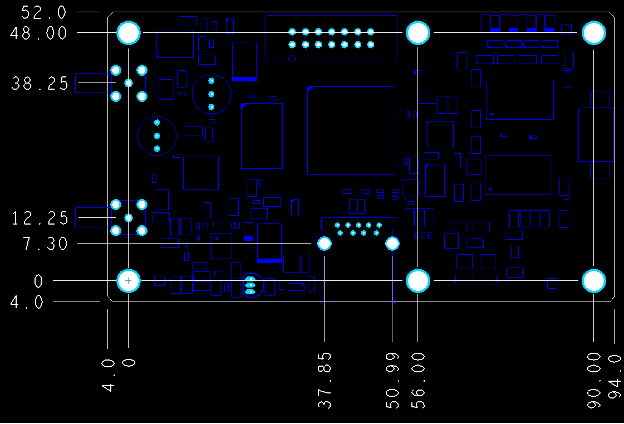
With ultra-high-density interconnect design, small features come with big decisions.
Ultra HDI (UHDI) has become a prominent part of the PCB design conversation, often presented as “the next frontier” in density and miniaturization. But before we move on to advanced routing strategies and design techniques, let’s establish a solid practical foundation. What is the difference between UHDI and the HDI processes, which so many designers have already learned to rely on? Why does the shift in the underlying process matter, and when does it become worth incorporating into mainstream design work? We will address those questions here.

What Ultra HDI Actually Means
Most designers are well-acquainted with traditional HDI: laser-drilled microvias, 3–4 mil line/space and the lamination cycles required to build stacked or staggered microvia structures. For many years, this combination carried us comfortably through 0.8mm and 0.65mm pitch devices, meeting the rising expectations of high-speed digital architectures.
UHDI pushes those boundaries further: not only with smaller geometries, but with fundamentally different processes to manufacture this technology. While definitions vary slightly among fabricators, UHDI HDI generally refers to:
- Line/space below 65µm.
- Very small capture pad and land sizes suitable for next-generation device pitches
- Tighter copper thickness control, which makes for more predictable electrical behavior
- Imaging methods that can continuously maintain such features in a semi-additive way.
In other words, UHDI is not simply “smaller HDI” but rather a different approach to manufacturing the copper structures themselves. The difference becomes particularly important when a design involves very fine-pitch BGAs, dense routing channels, or demanding RF and high-speed nets.
Why the Manufacturing Process Matters More Than It Used To
Conventional HDI is based on subtractive-etch processing. The process starts with copper foil laminated to the dielectric. Resist protects areas that are intended to become traces or pads, and exposed copper is chemically etched away. This works extremely well, up to a point. As trace widths shrink, several issues become more pronounced:
- Undercut becomes harder to control; traces may narrow beyond what is wanted.
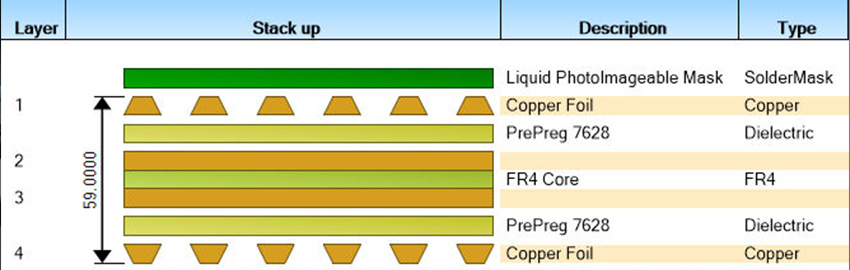
- Sidewalls taper, forming a trapezoidal cross-section.
- The final copper geometry may vary more from panel to panel than designers would like, especially for critical impedance nets.
These limitations begin to compete directly with electrical performance requirements as feature sizes fall below 75µm.
Semi-additive processes (SAP) approach the problem from the opposite direction. Rather than removing copper, they add to build it up. That process is as follows:
- Use a very thin seed layer or ultra-thin copper foils rather than full-thickness foil.
- Image the areas in which copper should be deposited.
- Plate copper onto the defined regions.
- The remaining seed layer or ultra-thin copper foil is removed in a controlled flash etch.
These traces have more vertical sidewalls and a more consistent geometry, which directly translates into tighter impedance control, reduced loss, and more predictable routing density. In UHDI features, geometry is not just a manufacturing outcome; it becomes a key enabling characteristic.
This is why UHDI requires designers and fabricators to work even more closely together. The imaging method influences what line/space can be reliably achieved, which in turn affects routing strategies, stackup planning, and the overall architecture of the board.
When to Consider UHDI
Not every design requires UHDI. Using it in situations where it is not required might add unnecessary cost. A number of design conditions start to indicate that it may be the correct choice, however.
- Device pitch and breakout constraints. BGA pitch often becomes the first clear indicator. Traditional HDI is good at 0.8mm and 0.65mm and can often achieve 0.5mm with careful routing strategies. However, as devices move closer to the threshold of 0.5mm, and especially below, fanout becomes increasingly constrained. Via escape patterns and routing channels rapidly consume available space, and layer count begins to rise. Subassembly strategy for complex microvia and buried/blind microvias is often used, driving cost and lead times higher.
- Size, weight and power (SWaP) requirements. Miniaturization pressure is playing an increasing role across the board, from wearables and medical devices to aerospace and advanced industrial electronics. UHDI enables routing density to make meaningful reductions in layer count and board area feasible.
Examples include reducing a 10-layer design to six or eight layers by opening additional routing channels, lowering overall thickness while maintaining electrical performance and improving component placement options through cleaner breakout geometry. This is where the SWaP benefits become tangible: the value of UHDI is not just about small traces but also architectural decisions that can be made with this technology to reduce size and complexity in the complete assembly.
- RF integrity and high-speed signaling. In RF or high-speed designs, the geometry of copper directly impacts insertion loss, impedance stability and signal isolation. The smooth, consistent copper features afforded by semi-additive processes can help minimize the variability in nets operating within narrow margins and UHDI geometries have provided the required discipline for maintaining consistent electrical performance across production lots. This benefit applies to traces greater than 75µm as well as to hold linewidths to very tight limits.
- Balancing cost and reliability. Moving to UHDI may affect the cost structure: more sophisticated imaging methods and tighter controls generally raise the cost per panel. The broader cost picture is more complex.
Total cost often balances out with UHDI because designs can use fewer layers, smaller board sizes, more efficient assembly through simplified breakout, greater flexibility in component placement and more stable impedance performance without relying on exotic or high-cost materials.
Reliability considerations can be mitigated with UHDI: denser via structures and smaller capture pads require careful attention to aspect ratios, thermal management, and the use of stacking strategies that minimize stacking.
Semi-additive geometries have improved consistency compared to traditional HDI, which reduces some of the variability.
Early collaboration with an experienced fabricator does make a difference. The process window for UHDI is different, and knowing where that window is most robust will guide better design decisions.
Key Design Implications
Once UHDI rules are in place, several design areas deserve early focus.
- Line/space usage. UHDI does not mean applying minimums throughout the design. The most successful designs use fine features in selected, strategic areas such as the BGA fanout region and other crowded areas, and relax the rules in open spaces where it is possible. This approach is much better to maximize yield and contain cost without sacrificing routing efficiency. Keeping the finest lines on specific layers helps cost by allowing for the mix of technologies. Subtractive etch may be used on power/ground layers and signal layers of 75µm or greater.
- Stackup planning. Layer reduction thus becomes a practical possibility, and the stackup often differs from traditional HDI designs. In many designs, Ultra HDI will permit more efficient routing channels, more flexibility in placing planes, and better control over impedance structures.
- Impedance accuracy. Because the copper thickness and geometry in semi-additive traces are more predictable, impedance calculations become more reliable, especially for designs with very small structures or pushing the limits of high-speed performance. Use of actual fabricator process data within modeling tools is critical; this ensures simulations reflect real manufacturing outcomes.
- Data packaging clarity. Fabricators may want to understand in more detail which features are needed and where the design rules can be relaxed. Clearly identifying the critical nets, functional regions and constraints aids in helping the fabricator optimize yield and manufacturability without sacrificing performance.
Where This Leads
Ultra HDI is much more than a set of smaller numbers on a capability chart. It introduces a process that supports tighter geometry, higher routing efficiency and improved electrical performance, provided that the design, stackup and manufacturing assumptions are aligned from the start.
The bottom line: the value of UHDI comes from making smart, informed decisions upfront. When process capabilities, routing strategy and electrical performance are all in concert with one another, designers have options, not limitations.
With the next article, we can move from foundational concepts to practice, looking at design for manufacturing considerations.
Anaya Vardya is chief executive of American Standard Circuits/Sunstone (asc-i.com); This email address is being protected from spambots. You need JavaScript enabled to view it..