Like a building foundation, the stackup supports every layer above it.
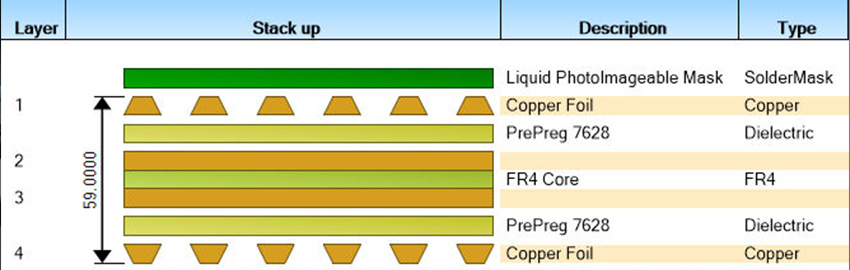
The way the printed circuit board layers shown in Figure 1 are arranged is called a stackup. It’s one of the most important constructs in a PCB design. In many ways, it’s configured just like the foundation of a building. If the stackup is weak or poorly planned, for example, everything built on it will suffer from instability, no matter how good the circuit design is.

Figure 1. Example of a PCB stackup.
Why the PCB Stackup Matters
As noted, proper circuit design can be undone by a poorly planned stackup. Here are some ways to think of how the board is constructed and the effects of a thoughtful approach.
Signal integrity (SI). Imagine shouting in a tunnel; your voice echoes and distorts. Poor stackup has the same effect on high-speed signals. A good stackup makes signals travel smoothly, with controlled “lanes” (impedance) and solid “walls” (ground planes) to keep them clean.
Electromagnetic compatibility (EMC). Have you ever held your phone next to a speaker and heard a buzzing sound? The source of that is known as interference. A proper stackup reduces unwanted “noise radiation” by keeping signal return paths close to ground planes.
Thermal and mechanical reliability. Think of a sandwich where one slice of bread is thick, and the other is paper-thin – it bends easily. A PCB works the same way. Symmetrical and balanced stackups prevent warping and help distribute heat evenly.
Prototype perspective. When you build the first prototype, the stackup is like your test recipe. You are evaluating several things:
- Can the fabricator achieve the planned impedance values?
- Do thin dielectrics really work for your signals?
- Does the board survive lamination without warping?
If the stackup isn’t right in the prototype, production will only multiply the problems.
Fine-pitch parts. Modern chips often come in BGA packages with very small pin pitch and edge-to-edge spaces (as small as 0.4mm (about 0.02") between pads). Escaping traces from these packages is like parking cars in a narrow alley. You need slim lanes (fine traces), smaller drills and sometimes “underground tunnels” (blind or buried vias). The stackup determines whether that’s even possible.
DfM (design for manufacturability). Think of DfM as designing not just for your idea, but also for the factory. Even if your design works on paper, can it be built repeatedly, reliably and at a reasonable cost? For example, if you choose exotic materials not available locally, your project may get delayed. If you stack too many microvias, yields may drop, and costs could skyrocket. A DfM-friendly stackup balances performance with manufacturability.
Steps to Build an Efficient Stackup File
To build an efficient stackup file, follow this process:
Step 1: Define the requirements. The first step is to define what the circuit actually needs. High-speed interfaces such as USB 3.0 or DDR require controlled impedance, while power-dense components call for thicker copper to carry higher current. If the design includes fine-pitch BGAs, thin dielectrics become necessary to enable proper breakout. For example, a board using DDR4 memory typically requires planning for 50Ω single-ended traces and 100Ω differential pairs within the stack-up.
Step 2: Select the materials. Different dielectrics behave much like different types of road surfaces: some offer smooth, low-loss “highways,” while others resemble rough, high-loss dirt roads. The choice depends on how fast the signals need to travel. Standard FR-4 is suitable for many designs, but for 5G, RF or other high-frequency applications, low-loss materials are often required.
Step 3: Plan layer arrangement. Planning a stackup is a lot like planning a city. Signals should travel alongside solid “ground highways” to ensure clean return paths. Power and ground layers belong close together, much like stacking the meat and cheese in a sandwich, to support stable power delivery. And keeping the structure symmetrical helps prevent bending as the board is manufactured.
Example of an 8-layer structure:
- L1: Signal
- L2: Ground
- L3: Signal
- L4: Power
- L5: Power
- L6: Signal
- L7: Ground
- L8: Signal
Step 4: Set dielectric thickness and copper weight. Dielectric thickness acts like the distance between traffic lanes; too wide, you lose control over impedance; too narrow, the board becomes difficult to manufacture. Copper weight works the same way: it’s essentially the width of the lane. Thicker copper can carry more current, but it also makes fine routing significantly harder. That’s why, in a BGA breakout, designers often choose 0.5oz. copper with 3-mil traces rather than 2oz. copper, which is simply too thick for that level of detail.
Step 5: Run impedance calculations. This is like checking lane width before painting road lines. Tools or fab calculators will tell you what trace width/spacing gives 50Ω or 100Ω. For example, if your fabricator says “with 3 mil dielectric, 4 mil trace = 50Ω”, that defines your PCB rules.
Step 6: Verify with fabricator (DfM check). Once the draft stackup is complete, confirm with the fabricator whether the “recipe” is actually manufacturable. They’ll determine whether the planned via sizes can be drilled reliably, whether the stack can be pressed without bow or warp, and whether the specified materials are available and supported in their process.
Step 7: Finalize and document. Once everything is validated, create a clear table that lists each layer’s name and function, the dielectric thickness and type (including Dk/Df), copper thickness, target impedances and any special notes such as “VIPPO for BGA pads.” This table becomes the blueprint that guides both your design team and the fabricator through the build.

Figure 2. A detailed PCB stackup table showing layer functions, copper weights, dielectric thicknesses and material specifications.

Figure 3. Single-ended impedance table comparing the customer’s intended trace widths and target impedances with the fabricator’s calculated values.
Tips for Signal Integrity
Keep signals adjacent to a ground plane whenever possible and avoid letting high-speed traces cross plane splits. Doing so is essentially the electrical equivalent of removing the bridge beneath a moving car.
Fast signals belong on innerlayers where they can be naturally shielded, and fine-pitch BGAs require early planning for microvias to ensure breakout is possible.
Throughout the design, maintain copper balance from left to right like a seesaw to prevent mechanical stress and warping.
Think of the PCB stackup as the DNA of your design; responsible for how signals behave, how heat moves and how reliably the board can be produced. A well-built stackup keeps signals clean without unwanted reflections or noise, helps the design pass EMC testing, supports fine-pitch components and can be manufactured repeatedly at scale without unexpected issues.
When teaching stackup design, I always say: “If schematic is your brain, then stackup is your backbone. Without a strong backbone, nothing else stands straight.”
Akber Roy is CEO and founder of RUSH PCB Inc. an electronics manufacturing company specializing in PCB design, fabrication, and assembly services; This email address is being protected from spambots. You need JavaScript enabled to view it. (rushpcb.com).