As PCB designs grow more complex, IPC-2581 offers a different approach to manufacturing data exchange.
The electronics industry has spent decades perfecting PCB design tools, automating verification, embracing digital twins and accelerating product development using AI tools. Yet when it’s time to send a design to manufacturing, many organizations still fall back on a process that hasn’t fundamentally changed in decades – export Gerbers, generate drill files, create spreadsheets, collect PDFs, zip everything together, and email the package.
This isn’t happening because there isn’t a better alternative. It’s happening because old habits are hard to break.
Today, virtually every major PCB design system – including Cadence, Altium, Siemens Pads and Xpedition, Zuken CR-8000 Design Force, Pulsonix, KiCad and Easy-PC – can generate IPC-2581 directly from the PCB editor. There are no additional translators to purchase, no special software to install and no licensing costs to create the file. For most designers, generating IPC-2581 is simply another output option already built into the tool they use every day.
The barrier is no longer technology. The barrier is mindset.
IPC-2581 was created by the industry, for the industry. It is an open, neutral global standard managed by GEA, not by any single software vendor. More than 120 companies worldwide now participate in its development and adoption because they recognize that modern manufacturing requires something more intelligent than a collection of disconnected files.
Instead of sending dozens of files that someone on the manufacturing side must interpret, IPC-2581 delivers a complete digital product model in a single intelligent file. Stackup, artwork, drill data, netlist, bill of materials, component placement, impedance requirements, fabrication notes and manufacturing specifications all travel together as one consistent dataset.
Manufacturers report reductions of up to 30% in pre-CAM engineering time because they spend less time searching for missing information, resolving inconsistencies and asking questions before production can begin. Once you account for the bidirectional capabilities of IPC-2581, eliminating endless, frustrating back-and-forth on package validation and the DfM exchange, both the designer and their manufacturing partners can save several weeks.
But efficiency is only one benefit. The real opportunity comes from changing the way design teams think about manufacturing data exchange.
Traditional Gerber packages, and even many ODB++ workflows, follow a one-way handoff model. Once the package leaves engineering, the entire design is typically shared with every manufacturing partner, regardless of how much information it actually needs. Fabricators, assemblers, stencil suppliers and test houses often receive the complete design database even though each partner requires only a portion of the information.
That approach made sense years ago. It doesn’t make sense today.
Modern product development is collaborative, connected and increasingly focused on protecting valuable intellectual property. IPC-2581 introduces capabilities that simply didn’t exist in any other manufacturing format.
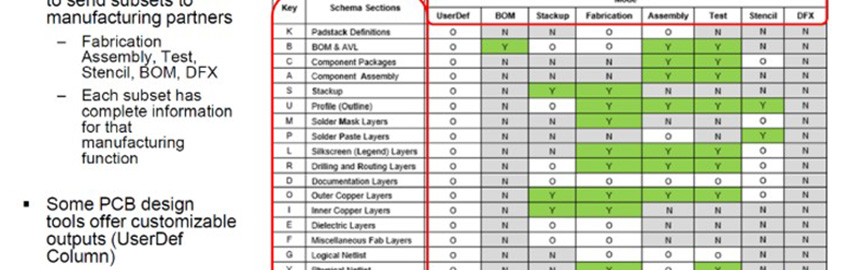
Its function mode allows engineering teams to generate purpose-built datasets for fabrication, assembly, stencil creation, testing, stackup review, DfX analysis and more. Each manufacturing partner receives only the information required to perform their specific task, and nothing more. That’s IP protection; the benefit is huge (Figure 1).

Figure 1. Built-in function modes enable IP protection. Some vendors allow users to create a user-defined mode to customize what content to send to a specific manufacturing partner.
IPC-2581 also enables something the industry has wanted for years: true bidirectional collaboration.
Instead of exchanging stackup revisions, manufacturability questions and engineering clarifications through disconnected emails and spreadsheets, IPC-2581 provides dedicated stackup exchange and DfX modules that allow technical information to move electronically between design and manufacturing teams. Questions become traceable. Feedback becomes structured. Communication becomes part of the digital product model rather than an external conversation.
No other manufacturing data standard provides this level of intelligent collaboration.
The good news is that adopting IPC-2581 doesn’t require changing your PCB design software. It doesn’t require purchasing expensive add-ons. It doesn’t require redesigning your products. In most cases, it simply requires selecting a different export option and committing to a smarter workflow.
Digital transformation isn’t about replacing people or replacing tools. It’s about replacing outdated processes with better ones.
Our industry has embraced model-based design, AI-assisted engineering, cloud collaboration and digital manufacturing. Yet many organizations continue to exchange manufacturing data using workflows that belong to another era.
The technology has already caught up. The standards are mature. The software is ready. The ecosystem supports it.
Now the only remaining question is whether we’re ready to leave behind the habits of yesterday and embrace the intelligent, secure, collaborative data exchange that modern electronics manufacturing deserves.
Here’s a simple challenge: spend 10 minutes generating an IPC-2581 file from an existing PCB design. It’s surprising how easy it is. Anyone familiar with generating Gerber or ODB++ data already understands most of the process.
Start by setting up the design as normal for manufacturing output, all artwork layers, drill data, fabrication details and other manufacturing information. Then, instead of selecting Gerber or ODB++, simply choose IPC-2581 from the PCB design tool’s File → Export (or Import/Export) menu (Figures 2, 3 and 4).

Figure 2. Exporting data to an IPC-2581 file is easy.

Figure 3. IPC-2581 export options are built directly into most major PCB design tools, making file generation a straightforward part of the manufacturing output process.

Figure 4. Creating an IPC-2581 file typically requires only a few configuration selections before generating a complete digital manufacturing dataset.
Most PCB design tools will ask for just a few additional choices:
- Select the IPC-2581 revision. Choose the version supported by your manufacturing partner. Today, most fabricators and assemblers support IPC-2581B or C.
- Select what to export. This is where IPC-2581 stands apart. Unlike traditional manufacturing packages, it does not require every dataset to be shared. Available export options include fabrication data only (excluding component information), assembly data only (excluding innerlayer artwork) and stencil, DfX, stackup or other purpose-specific datasets. Many companies use this capability to protect valuable intellectual property by sharing only the information each manufacturing partner needs.
- Choose a filename and generate the file.
That’s it.
After the file is exported, it can be reviewed directly in many PCB design tools that support IPC-2581 import and visualization. For tools without native support, free IPC-2581 viewers are available from providers including Wise Software, Siemens, ZofzPCB and PCB Preflight. Download links for these viewers can be found on the IPC-2581 Consortium website under Resources → Free Viewers.
Spend a few minutes exploring what is inside the file. Compare it with the collection of Gerbers, drill files, spreadsheets, PDFs and notes normally sent to manufacturing. The contrast between fragmented manufacturing packages and an intelligent digital product model quickly becomes apparent.
The hardest part of adopting IPC-2581 isn’t learning how to generate it. It’s deciding that it’s time to move beyond a workflow we’ve outgrown.
The tools are ready. The ecosystem is ready. The standard is mature.
The only question left is whether we’re ready to let go of yesterday’s habits and embrace a smarter, more secure and collaborative way of exchanging manufacturing data. You can reach out to the IPC-2581 Consortium if you have any questions – just fire off an email to This email address is being protected from spambots. You need JavaScript enabled to view it.. What are you waiting for?
Hemant Shah is an EDA veteran and chair of the IPC-2581 Consortium (ipc2581.com). Shah led the effort to create an industry-wide consortium of design and supply chain companies to get IPC-2581 – the standard for transferring PCB design data to manufacturing – adopted.
He spent 20 years at Cadence as product manager for various PCB design products. Shah also led the industry adoption of the IBIS-AMI algorithmic modeling standard. Prior to joining Cadence, Shah worked at Xynetix and Intergraph. He is passionate about developing and marketing leading-edge software products for PCB design. The IPC-2581 Consortium is holding a free IPC-2581 Adoption Summit on Oct. 1, 2026, as part of PCB West.