Breaking through the 100GHz bandwidth limit for coplanar waveguide design with a ground guard sheet in mmWave applications.
Millimeter wave (mmWave), or millimeter band, is an electromagnetic (EM) frequency range below infrared (IR). The frequency spectrum of mmWave is applied for high-speed telecommunications, such as 5G and potentially 6G network deployment.1,2 Referring to Figure 1, the mmWave wavelength ranges from 10mm at 30GHz to 1mm at 300GHz.
Wireless communication in the mmWave band is fast and low-latency, enabling higher data rates than other telecommunications in lower-frequency bands, such as existing cellular networks. With its higher data rate and capacity, the mmWave network handles more data traffic than other frequency bands. Furthermore, mmWave does not propagate or interfere with the neighboring cellular network system.

Figure 1. Frequency spectrum and wavelength of mmWave versus cellular.
To minimize transmission line loss in the PCB used in the mmWave application, stringent signal trace routing is required. To align with this aim, this paper presents an optimization study of the coplanar waveguide (CPW) structure in terms of transmission-line design to achieve minimal loss and a resonant dip across a bandwidth beyond 100GHz.
The work detailed here involves two phases, i.e., three-dimensional electromagnetic (3DEM) modeling of the CPW transmission line using Keysight EMPro in phase one, followed by analyzing the insertion loss (S21) and time domain reflectometry (TDR) using Keysight Advanced Design System in phase two to compare the loss performance between CPW design with ground guard sheet versus conventional guard vias.
Analysis and Results
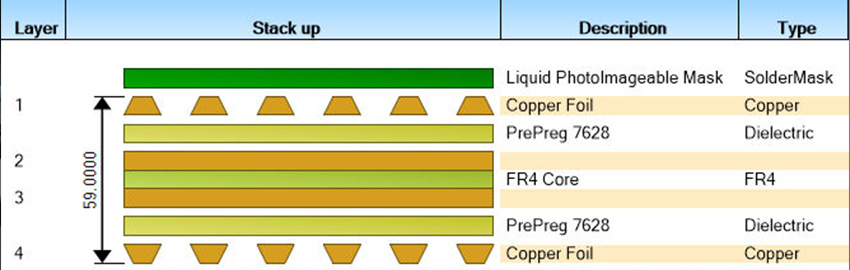
Loss performance analysis for CPW with conventional guard vias. The CPW 3DEM models with guard vias are constructed in EMPro, and the top view is shown in Figure 2. The signal trace and its side ground planes on layer one have a 1oz. thickness, a 7mil trace width, and a 4mil gap (edge-to-edge on each side), laid 4mil above a solid ground plane on layer two, with the Megtron 6 dielectric laminated between the two copper layers. The CPW structure is 500mil long. The nominal characteristic impedance of the signal trace is 50Ω, calculated based on the six equations shown in Figure 3.3 There is a row of guard vias on each side of the signal trace, connecting the ground planes on layers one and two. Each via’s diameter is 10mil. Ports 1 and 2 are positioned at each end of the signal trace.
The parameters Dx (spacing between two vias, center to center) and Dy (spacing between via and trace, center to center) are varied for four microstrip models to investigate the guard via position impact on the transmission loss performance of CPW, i.e., model A1 is set with Dx 15mil and Dy 30mil, model A2 is set with Dx 15mil and Dy 60mil, model B1 is set with Dx 30mil and Dy 15mil, model B2 is set with Dx 60mil and Dy 15mil.

Figure 2. Top view of CPW 3DEM models in EMPro.

Where
Zo = signal trace characteristic impedance
K() = elliptic integral
a = trace width
b = sum of trace width and gaps on either side
h = laminate thickness
Ԑr = dielectric constant
Ԑeff = effective dielectric constant.
Figure 3. Equations used to calculate characteristic impedance and effective dielectric constant for coplanar waveguide structures.
The resulting plots of S21, TDR and electric field with varied parameter Dy are depicted in Figure 4 and Figure 5, respectively. Referring to Figure 4, CPW model A1 with Dy 30mil and A2 with Dy 60mil encounter a resonant dip at 73GHz and 32GHz, respectively. Based on Eq. 7,4 the quarter wavelength at frequency 7 GHz and 32GHz on PCB laminated with Megtron 6 is 21.6mil and 49.3mil, respectively.

Figure 4. S21 plot for CPW models with varied Dy.

Where
λ = signal wavelength
c = speed of light
f = signal frequency
Ԑr = dielectric constant.
Eq. 7
On the other hand, referring to the TDR plot in Figure 5, CPW model A1 faces a slight impedance fluctuation, and model A2 suffers a larger fluctuation due to dielectric dispersion.

Figure 5. TDR plot for CPW models with varied Dy.
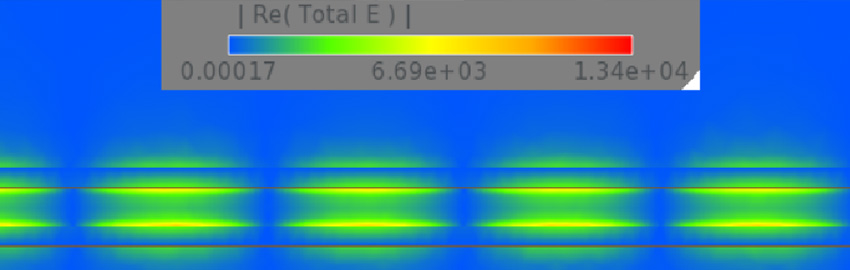
Meanwhile, Figure 6 shows that the electric field is more localized around the transmission line for CPW model A1, compared to A2.

Figure 6. Electric field plot for CPW models with varied Dy.
The signal transmission line also serves as an electromagnetic radiation source that emits an electromagnetic wave outward, with approximately a quarter wavelength. Besides that, the electric field is more localized in CPW with more closely positioned guard vias, or vias’ center to center spacing below quarter wavelength, which helps minimize the electric field radiation, spurious coupling, and dielectric dispersion, which in turn mitigates impedance fluctuation and insertion loss.6,7
Subsequently, the resulting plots of S21, TDR, and electric field for varying Dx are depicted in Figure 7, Figure 8 and Figure 9, respectively. Referring to Figure 7, CPW model B1 with Dx 30mil and B2 with Dx 60mil encounter a resonant dip at 76GHz and 32GHz, respectively. Based on Eq. 7,4 the quarter wavelength at frequency 76GHz and 32GHz on PCB laminated with Megtron 6 is 20.75mil, 49.3mil, respectively.

Figure 7. S21 plot for CPW models with varied Dx.
On the other hand, referring to the TDR plot in Figure 8, CPW model B2 exhibits greater impedance fluctuations than model B1 due to more severe dielectric dispersion.

Figure 8. TDR plot for CPW models with varied Dx.
Meanwhile, Figure 10 shows that the electric field is more localized around the transmission line in CPW model B1 than in B2. As a result, model B2 suffers from more critical dielectric dispersion and impedance fluctuation.

Figure 9. Electric field plot for CPW models with varied Dx.
Loss performance analysis for CPW with ground guard sheet. The 3DEM Model C uses the same PCB stackup and physical constraints as the other four models but replaces the guard vias with 1mil thick guard sheets positioned on either side of the signal trace. The guard sheets connect the ground planes on layers 1 and 2 and extend 500mils along the transmission line. The electric field distribution, TDR response and S21 performance of the guard-sheet design were analyzed and compared with those of a conventional CPW using guard vias.

Figure 10. Top view (left) and 3-D view (right) of CPW model C.
Referring to E-field, TDR, and S21 plots in Figure 11, Figure 12 and Figure 13, respectively, the E-field experienced by CPW model C with guard sheet is more localized around the transmission line vs. CPW models A1, A2, B1 and B2. The E-field hardly radiates through the solid guard sheet. As a result, dielectric dispersion is less severe, which in turn contributes to a more stable, smoother impedance profile around the nominal 50Ω level. Ultimately, CPW model C can experience a smooth S21 curve, without a significant resonant dip, up to 170GHz. Its S21 of –1.6dB at 170GHz is caused by Megtron 6 dielectric attenuation.

Figure 11. E-field profile for CPW model C.

Figure 12. TDR plot for CPW model C.

Figure 13. S21 plot for CPW model C with ground guard sheet.
Based on Eq. 7, 170GHz signal bandwidth and beyond has a quarter wavelength below 9mil. The standard PCB capability can only be achieved via a pad diameter as small as 15mil,8 which means that the via center-to-center distance is at least 15mil. Even the advanced PCB capability can only fabricate a board with a via pad diameter as tiny as 10 mil and hence a center-to-center spacing of 10 mil minimum.8 Therefore, the guard vias hardly impede the 170GHz E-field radiation and dielectric dispersion. On the contrary, the analysis results indicate that the solid guard sheet without any voids is an ideal alternative for hindering E-field radiation, dielectric dispersion, and resonant dip up to 170GHz. In practice, a ground guard sheet can be implemented on a PCB using 3-D printing9 or PCB milling.10
Conclusion
This work provides an overview of the mmWave and frequency range used in 5G and 6G telecommunications. Besides that, this work also presents a study that alleviates transmission loss in CPW beyond 100GHz. Analysis results show that by substituting the conventional guard vias with a solid guard sheet for a CPW with 500mil length, the insertion loss is held below -1.7dB without a significant resonant dip up to 170GHz bandwidth.
References
- R, Awati, et al., "What is Millimeter Wave (mmWave)?," Tech Target, Nov. 18, 2025, https://www.techtarget.com/searchnetworking/definition/millimeter-wave-MM-wave.
- D. Meyer, "What Role Will mmWave Spectrum Have in 5G and 6G?" SDXCentral, Jul. 7, 2023, https://www.sdxcentral.com/analysis/what-role-will-mmwave-spectrum-have-in-5g-and-6g/.
- Brian C. Wadell, Transmission Line Design Handbook, Artech House, 1991.
- Apex Waves, “Transverse Electromagnetic (TEM) Wavelength Calculator,” https://www.apexwaves.com/free-tools/calculators/wavelength-tem-calculator.php.
- A. Mittal, “PCB Substrates: Knowing the Dielectric Material’s Properties,” company website, Nov. 17, 2022, https://www.protoexpress.com/blog/pcb-substrates-knowing-dielectric-materials-properties.
- M. Steer, Microwave and RF Design II: Transmission Lines, North Carolina State University, 2023, https://eng.libretexts.org.
- M. Grady, et al, “Improved Bandwidth Using a 3-D Printed Quasi-Ideal Grounded Coplanar Waveguide Transmission Line,” IEEE Wireless and Microwave Technology Conference (WAMICON), April 2022, https://ieeexplore.ieee.org/document/9786166.
- AdvancedPCB, “Advanced PCB Manufacturing Capabilities,” https://www.advancedpcb.com/en-us/resources/manufacturing-capabilities/.
- M. Grady et al., “Improved Bandwidth Using a 3-D Printed Quasi-Ideal Grounded Coplanar Waveguide Transmission Line,” IEEE Wireless and Microwave Technology Conference (WAMICON), 2022.
- Printed Circuit Board Milling, Wikipedia, https://en.wikipedia.org/wiki/Printed_circuit_board_milling.
Chang Fei Yee is a senior staff engineer with Keysight Technologies, specializing in electronic hardware, signal integrity and power integrity.