Features

Lauren Waslick and Kristen Aguiar discuss mentorship, visibility and the career few people know exists.

One of the PCB design community’s greatest talents is hiding in plain sight.

Ask a room full of high school students what they want to be when they grow up and you'll hear doctor, lawyer, engineer, teacher, maybe even influencer if we're being honest. In my own case, I wanted to be a writer. I simply failed to anticipate that the characters would be engineers.

Read more ...

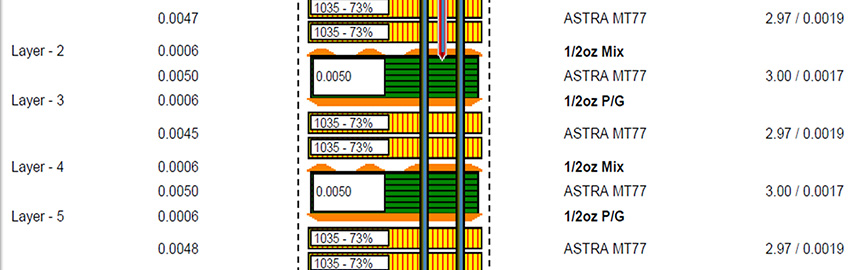
Applying UHDI only where density and performance demands require it can reduce layer counts, improve yields and lower costs without sacrificing electrical performance.

One of the most common assumptions PCB designers make when investigating ultra HDI (UHDI) technology is that every layer must be built with ultra-fine geometries using semi-additive processing (SAP) or modified semi-additive (mSAP) processing. In practice, most UHDI stackups are a combination of conventional layers and UHDI layers. This approach – call it selective UHDI – places UHDI layers exactly where they deliver the most benefit and lets conventional layers handle the rest, resulting in a mixed-process stackup.

Read more ...

How to specify, validate and monitor PCB backdrill requirements during NPI and production.

As PCB designs incorporate higher-speed signals, and reducing via stubs becomes critical to function, backdrilling is often treated as a simple requirement added to the fabrication drawing. Designers trust the PCB fabricator's process to meet their stub requirement, but validation of this critical requirement is often overlooked.

Read more ...

Breaking through the 100GHz bandwidth limit for coplanar waveguide design with a ground guard sheet in mmWave applications.

Millimeter wave (mmWave), or millimeter band, is an electromagnetic (EM) frequency range below infrared (IR). The frequency spectrum of mmWave is applied for high-speed telecommunications, such as 5G and potentially 6G network deployment.1,2 Referring to Figure 1, the mmWave wavelength ranges from 10mm at 30GHz to 1mm at 300GHz.

Read more ...

As laminate shortages reshape PCB development timelines, early collaboration is becoming critical to keeping complex designs manufacturable and on schedule.

Printed circuit board development timelines continue to compress, driven by faster design cycles, tighter launch windows and increasing product complexity. While EDA tools and automation have improved dramatically, one long-standing challenge persists: translating design intent into a manufacturable, buildable and repeatable product.

Read more ...

As PCB layouts move into UHDI territory, registration, alignment and tolerance stackup become critical factors in determining whether designs can be manufactured consistently and reliably.

Ultra high-density interconnect (UHDI) design gets attention for all the right reasons. For PCB designers, UHDI enables smaller feature sizes, higher routing density, fewer layers and greater flexibility in areas where conventional HDI begins to run out of room. Those benefits are real. Just as important is the shift in design mindset that comes with them, however. Once a layout moves into UHDI territory, the challenge is no longer only whether the design can be routed. The challenge is whether the design can still align, repeat, and build consistently during fabrication.

Read more ...

Page 1 of 96

Subcategories