In the previous newsletter, I wrote about the possibility of using our electronics advancements to create detection devices for the novel coronavirus.
I received many comments and ideas for these new medical devices. Several commented on current electronic projects intended to develop detection and diagnosis equipment.
The idea is to create a wearable electronic sensor that attaches to your body. The substrate requirements are different from those used in traditional materials (polyimide films or PET films). Device substrates have to be flexible and elastic to remain attached during body movements; urethane and silicone rubber could be an option. Larger-sized devices will require a permeable substrate to address moisture from sweating. One option for this basic material is to use adhesive bandages along with an appropriate coating material or glue. Copper foil, the standard conductor material for printed circuit boards, is not suitable for a wearable device because of its poor elasticity. Using meander patterns as conductors can improve the copper foil circuits’ elasticity, but it is not enough for general use. One alternative for wiring electronic devices is screen-printable conductive ink. The elasticity from the conductive ink can increase by adding a rubber component for the binder matrix.
To continue reading, please log in or register using the link in the upper right corner of the page.
SiP, MCP and DDR5 support faster speeds and higher power requirements.
Ed.: This is the sixth of an occasional series by the authors of the 2019 iNEMI Roadmap. This information is excerpted from the roadmap, available from iNEMI (inemi.org/2019-roadmap-overview).
New high-end computing system technologies becoming available for such applications as servers, telecom and the cloud must meet bandwidth, power, thermal and environmental challenges. Advanced packaging technologies that can drive integration and increase functionality, at acceptable cost and risk levels, will be key enablers for the sector.
To continue reading, please log in or register using the link in the upper right corner of the page.
Written by Lenora Clark, Paul Salerno and Senthil Kanagavel
Category: Features
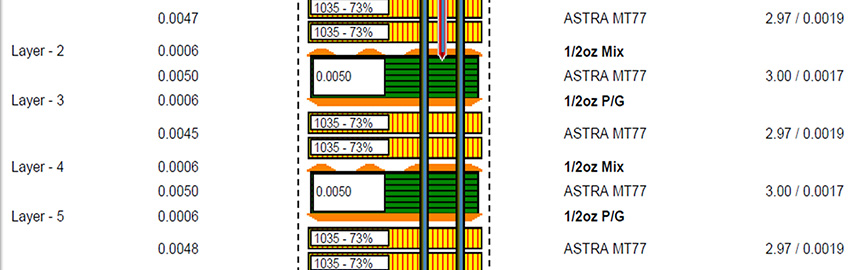
A holistic view of 77GHz radar sensors as a PCBA build, considering fabrication, assembly and packaging materials.
The Society of Automotive Engineers (SAE) and US Department of Transportation classify levels of vehicle autonomy from 0 to 5. Level 0 incorporates no automation; levels 1-3 have varying degrees of partial assistance to the driver, where the automobile, for example, can control steering, acceleration and deceleration, and even interfere with the driver. Finally, in full autonomy, level 5, the car drives on its own and makes all decisions and reactions to its surroundings.1
The automotive market uses a combination of sensors to make these critical decisions. Radar designs are the fastest growing sensors in ADAS today, due to the longer-range capabilities and their resistance to all weather conditions.2 This research will focus on radar designs, specifically long-range 77GHz radar, to showcase how automotive materials are changing and, through the choice of alternatives to those conventionally used in the space, how product life and reliability can be enhanced.
To continue reading, please log in or register using the link in the upper right corner of the page.
Recent salary survey results suggest newcomers may be entering the field.
Each year PCD&F surveys the PCB design community concerning issues surrounding their profession. For years, the feedback has had one connecting thread: Many PCB designers are experts with decades of experience. Their retirement has loomed large and has been widely anticipated, accompanied with concerns – and a little trepidation – about who will replace them. In conference classes and site visits in recent years, companies have discussed how they are working with educators at universities and local colleges to inform engineering students about industry opportunities. Recent survey results hint their efforts may be starting to pay off. And the time for boomer retirements is here.
PCD&F conducted its annual design engineers’ salary survey in early 2020, receiving 254 qualified responses from bare board designers, managers and design engineers. Data compiled included job titles and functions, ages, years of experience, education, location, types of projects, annual salaries and sales, job satisfaction and challenges, ECAD tools used, and years left in the field, among other data. While year-over-year changes are shown, they are for comparison only, and should not be assumed to be definitive.
To continue reading, please log in or register using the link in the upper right corner of the page.
Via temperature is determined by the temperature of the trace associated with the via, not the current itself.
Many designers and some EDA design tools place heavy emphasis on current density when sizing traces for a given current. Current density is current/unit area. Thus, it does make some intuitive sense that trace temperature might be proportional to current density: the higher the current, the higher the current density, and therefore the higher the temperature. But it is much more complicated. Following this design rule blindly may lead to significant design errors, especially when designing vias for allowable current. And a few examples will illustrate why.
To continue reading, please log in or register using the link in the upper right corner of the page.
Novel coronavirus infection rates decreased over the past few weeks, and several countries are planning to ease stay-at-home restrictions that will permit some businesses to open.
The global economy is in a freefall, and small and large companies struggle to survive.
There is no specific treatment for coronavirus, and a vaccine is still months away. Virus testing for coronavirus is key, but it’s difficult to administer to millions of people. Polymerase chain reaction (PCR) is a technique used to amplify small segments of DNA; in layman’s terms, once you have your throat swabbed during a coronavirus test, the swab is ready for polymerase chain reaction testing. This test is not cheap, and PCR testing is not 100% accurate. A positive test result is 100% accurate, but 30% of the time you can receive a false negative result, meaning that people with an active Covid-19 infection still test negative for the disease.
To continue reading, please log in or register using the link in the upper right corner of the page.