| Improving Fabrication Yields |
|
|
| Written by Zulki Khan | |||
| Friday, 01 January 2010 00:00 | |||
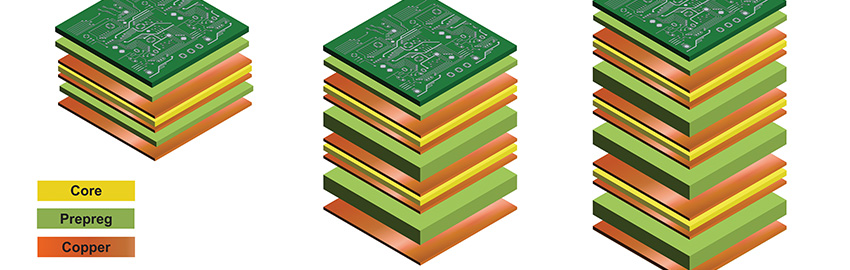
How the CAM engineer can make the difference.Embedded in fabrication planning is calculating panel size, checking layer stackup information, reviewing expected yields, reviewing board construction and verifying impedance control calculations. Typical panel sizes are 9 x 12˝, 12 x 18˝, 18 x 24˝, or 18 x 36˝. A number of factors need to be considered when calculating panel size. For instance, consider a small board of 25 sq. in. A relatively high number of this small board can be panelized in an 18 x 24˝ panel. But board complexity and density, or such factors as high-speed signals, trace thicknesses, or controlled impedance, could favor a 9 x 12˝ panel. Stackup calculation is another planning aspect. Figure 1 shows the construction of an eight-layer board stackup with properly calculated layer and prepreg thickness. Stackup depends on the number of layers, the construction design, and the prepregs. It’s important to understand how a PCB’s layers and prepregs are constructed because they come in different amounts of copper. They also come in different thicknesses, and depending on the number of layers, board construction can change, thereby either increasing or decreasing yield. When impedance control calculations are involved, the CAM engineer should work closely with design engineers. Innerlayer registration. Buried capacitance (or buried resistance) is a technique sometimes applied when there is no available surface real estate to place passive components or when placing them creates noise that cannot be suppressed. In such instances, innerlayer registration requires special attention. Extremely thin prepregs (in the range of 0.002˝) demand careful handling. It is very hard to align such thin prepreg material during internal layer lamination process.
CAM engineers must ensure internal layers are properly registered, taking into account potential shifts occurring in layer construction. Fine-pitch devices require careful attention because they use extremely thin traces, thus posing impedance calculation issues. AOI is a solution here. AOI can check for internal shorts or opens before or even after boards are laminated, although changes after the latter are expensive. If mechanical drills are used for holes in the range of 0.006˝ to 0.009˝, extra-fine drill bits with extremely tight tolerances are required. Also, routing issues come into play when components are stacked toward the board edge. If the tolerances are not tight, the drilled holes can encroach into other areas, possibly damaging traces or pads. A word of caution. It’s not a good idea to stretch the technology. Put another way, a fabricator may not have the most advanced technology in-house. If outdated equipment is pushed beyond its limits, fabrication yields may decrease. For example, an older mechanical drill may be designed to form 0.008˝ holes, but the design calls for 0.005˝ holes. The situation may call for a laser drill, as mechanical drills lack the precise tolerance needed, which could result in overly large or wide drilled holes. Cutting into other traces or creating opens or shorts jeopardizes board integrity. It’s better to match the technology to the level of board fabrication complexity. Manufacturing practices. In board fabrication, good manufacturing practices go hand-in-hand with advanced technologies. Those preventive maintenance practices are synonymous with maintaining and properly and frequently calibrating fabrication equipment and systems. Precise calibrations are critical for ensuring proper drilling, routing, etching, and maintaining plating and etching chemistries. Another best practice to increase fabrication yield is copper thieving. It is used to balance the copper on the PCB surface, making the etching uniform and thereby reducing the chances of board warpage (Figure 2).
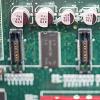
First-article creation and inspection represents yet another important aspect that can tremendously improve fabrication yields. At the beginning stage, after CAM planning is done, the fabricator should create a first article by aligning all the drill holes with through-hole pads, creating drilling and routing files, and checking power and ground planes for opens and shorts. A first-article board is then built to make sure all the critical factors are properly addressed. Chemistries. A fabricator has an assortment of chemical tanks. Maintaining effective chemistry balance is vital in etching tanks and plating lines. It is always a good idea for a fabricator to maintain an in-house chemical laboratory that can frequently monitor the chemistry in each bath. Some types of chemistry require checking every day – others every two to three days, depending on their processes and critical elements constituting those chemistries. Maintaining proper chemistries can boost board yield. If tank chemistries are not monitored properly, it can cause contamination, thereby creating uneven plating (Figure 3).
Finally, advanced fabrication equipment technology and preventive maintenance are inextricably intertwined; one isn’t effective without the other. Proper calibrations and maintenance are demanded when fabricators perform special builds such as countersink holes, back or stub drilling, or sequential laminations.
|
|||
| Last Updated on Thursday, 07 January 2010 20:33 |
Design News
- Cadence Returns to Profitability in Q2
- NI Reports Stellar Q2; Record Year Forecast
- Mentor, NI Provide Test Feedback for Designers
- EDA Ranking Shakeup First in Years: UPDATED
- IPC Updates Surface Mount Land Pattern Standard
- Mentor Announces PCB Technology Leadership Awards
- Report: Q1 EDA Revenue Up 4.6% to $1.25B
- Registration Open for PCB West 2010
- New Parts Library Site Follows 'Wiki' Model
- Icahn Boosts Mentor Stake to 11%
Market News
- June NA Printed Circuit Orders Up 28%
- Semi Gear Orders Up Again in June
- Global Q2 PC Shipments Up 21%, Gartner Says
- Components Orders Hit 2-Year High
- US Electronic Warfare Systems Market to top $1.4B by 2015
- SIA: May Global Chip Sales Up 48% YoY
- June Manufacturing Grows at Slower Rate
- May PWB Orders Up 47% YoY
- Report: Q1 Notebook PCs Reach $31B
- Gartner Forecasts 113% Rise in Semi Gear Spending
Fab News
- Eurotech Constructs UK facilities
- DuPont's Electronics Unit Up 53% in Q2
- Sanmina-SCI Swings to Q3 Profit
- PWB Maker Schweizer Rebounds Big
- Meiko to Expand in China, Vietnam
- Camstar Buys SigmaQuest
- Multek Sales on Record Pace
- APCB to Buy CKL
- AT&S Turns in Big Fiscal Q1
- M-Flex Says Prelim. Q3 Sales Up Nearly 4%
Products
Ansoft Designer 6.0 Solver on Demand technology analyzes signal-integrity, power-integrity and electromagnetic interference problems from a single schematic- and layout-based environment. Can access field and circuit simulation tools while designing electronic packages and PCBs early in the design cycle. Integrates HFSS 3-D electromagnetic field simulation software and HSPICE IC simulation. Can predict how high-frequency electromagnetic components affect ICs. Provides user interface to HSPICE with direct links to HFSS and access to the ANSYS QuickEye and VerifEye convolution and statistical...
Sponsor Links
Low Cost PCB Prototypes
PCB-POOL® manufactures high quality PCB prototypes at exceptional prices!
Receive instant quotes (no registration required) and order your PCBs directly online.
Special Offer: Free Laser SMD stencil with all prototype orders!
Need PCB prototypes fast?
Sunstone Circuits takes the pain out of prototyping! We are dedicated to making the online ordering of PCB prototypes simple, fast, and easy from quote to delivery. Quick access to our 24/7/365 customer service team and easy online order tracking takes the pain out of sourcing prototypes online.
Put us to the test - order Sunstone Circuits today!
Features
Component Layout“PCB Design and Assembly for Flip-Chip and Die Size CSP”Author: Vern Solberg; vsolberg123@aol.com.Abstract: This paper outlines the basic elements furnished in the newly released IPC-7094, Design and Assembly Process Implementation for Flip-Chip and Die Size Components, providing a comparison of existing and emerging wafer-level and chip-size package methodologies. The focus is on the effect of PCB design and assembly of bare die or die-size components in an uncased or...